Cost per serving is the most useful basic value comparison for supplements. It is simple to calculate, but only reliable when the inputs are verified.
The basic calculation
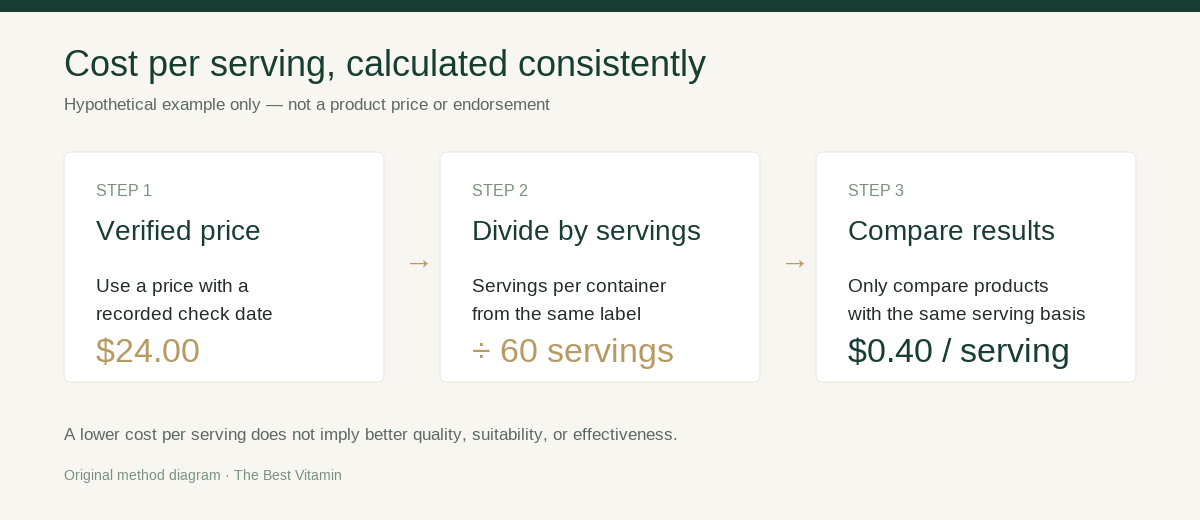
Divide the displayed price by the number of servings on the label. A $24 bottle with 60 servings costs $0.40 per serving. A $36 bottle with 180 servings costs $0.20 per serving. This comparison is only valid if both packages list the same serving size definition.
Going one step further
Where two products list the same form and amount of a nutrient, you can calculate cost per unit — for example, cost per 1,000 IU of vitamin D or per 100 mcg of B12. This is only meaningful when the forms are comparable and the amounts are fully disclosed.
Caveats
Prices change, promotions expire, and some products are sold through different channels at different prices. Record the retailer, price, currency, and date. Do not use a price from an unverified listing. A lower price per serving does not imply better quality or better suitability.
Our product records
Where a price can be verified, product records show the price, price date, and calculated cost per serving. Where it cannot, the field says “price not verified” rather than showing an estimate.