Dietary Reference Intakes (DRIs) are population reference values. They are frequently confused with daily values on labels and with amounts found in supplements. This guide defines the terms used by the National Academies and NIH’s Office of Dietary Supplements.
RDA — Recommended Dietary Allowance
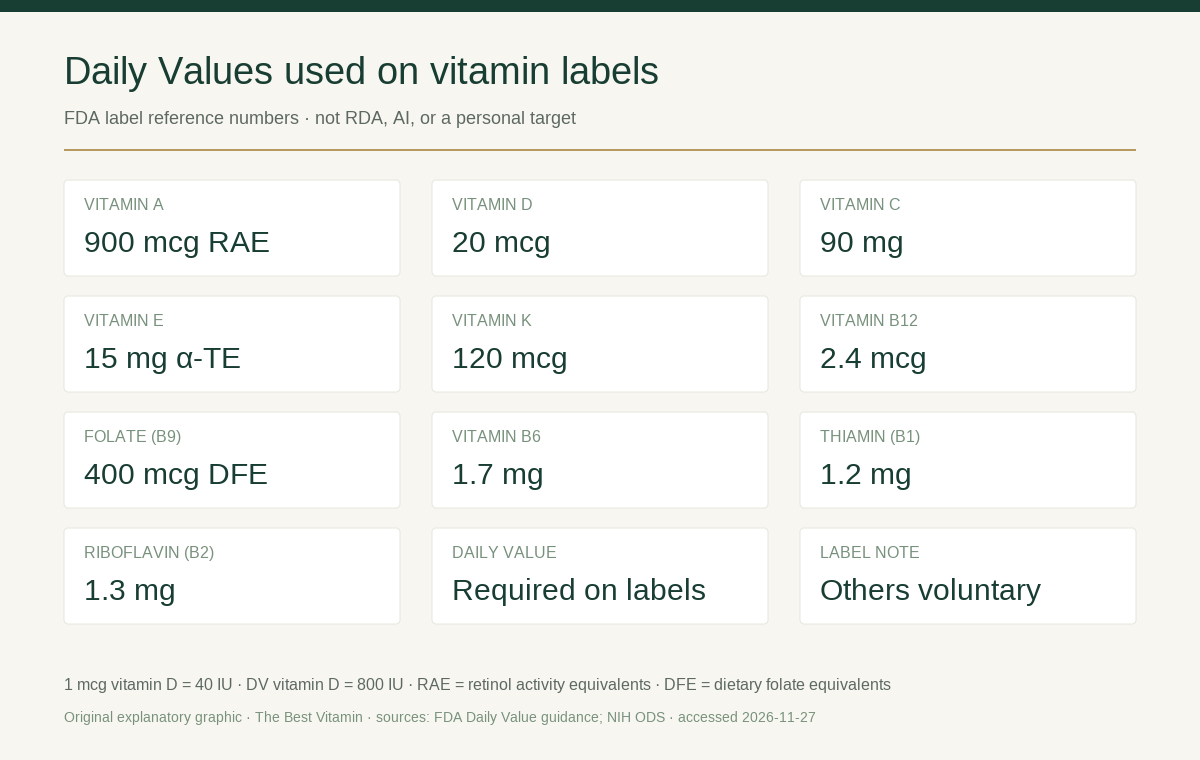
The RDA is the average daily intake level sufficient to meet the nutrient requirement of nearly all (97–98%) healthy individuals in a particular life-stage and sex group. Examples from NIH ODS: vitamin D 15 mcg (600 IU) for adults 19–70, vitamin C 90 mg for men 19+ and 75 mg for women 19+, vitamin B12 2.4 mcg for adults, and vitamin A 900 mcg RAE for men and 700 mcg RAE for women.
AI — Adequate Intake
An AI is set when evidence is insufficient to calculate an EAR and therefore an RDA. Vitamin K is an example: there is no RDA; the AI for adult men is 120 mcg/day and for adult women 90 mcg/day. An AI is a target for intake, but it is less certain than an RDA.
UL — Tolerable Upper Intake Level
The UL is the maximum daily intake unlikely to cause adverse health effects in almost all people. It is a boundary, not a goal. Some nutrients have no established UL because evidence of toxicity is weak: thiamin, riboflavin, B12, vitamin K, and food folate. Others have specific ULs: vitamin A (preformed) 3,000 mcg/day for adults, vitamin C 2,000 mg/day, vitamin D 100 mcg (4,000 IU)/day, vitamin E 1,000 mg/day, B6 100 mg/day, and synthetic folate 1,000 mcg/day.
EAR and CDRR — briefly
The Estimated Average Requirement (EAR) is the intake estimated to meet the requirement of half of a healthy population; RDAs are derived from EARs. The Chronic Disease Risk Reduction Intake (CDRR) is a newer DRI category used for a small number of nutrients. You will see EAR referenced in technical documents more often than on consumer labels.
Why supplement amounts are different
Standalone supplements commonly contain amounts far above RDAs. NIH ODS notes that B12-only products often provide 500–1,000 mcg and vitamin E-only products 67 mg or more. These are observed label amounts, not recommended intakes, and not dietary reference values. Clinical doses used in trials under medical supervision are also separate from RDAs.
Using the values responsibly
RDA/AI values apply to total intake from food and supplements in healthy population groups. They do not account for pregnancy, certain medical conditions, medications, or individual circumstances. This publication does not provide individualized dosage advice.