The % Daily Value column on a Supplement Facts panel is often misread as a personal requirement. It is a labeling reference designed to help consumers compare the nutrient content of products in the context of a total diet.
FDA Daily Values for vitamins
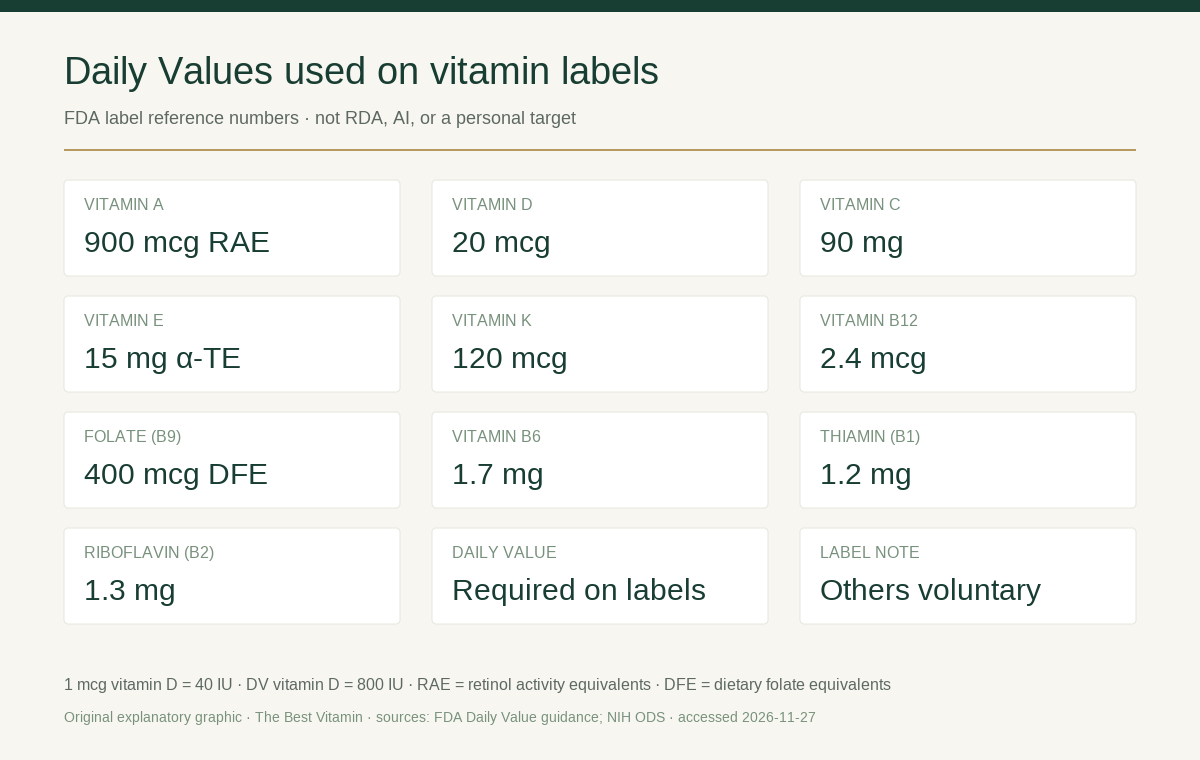
| Nutrient | Daily Value | Label note |
|---|---|---|
| Vitamin A | 900 mcg RAE | Voluntary unless added or claimed |
| Thiamin (B1) | 1.2 mg | Voluntary |
| Riboflavin (B2) | 1.3 mg | Voluntary |
| Vitamin B6 | 1.7 mg | Voluntary |
| Folate (B9) | 400 mcg DFE | Folic acid shown in parentheses |
| Vitamin B12 | 2.4 mcg | Voluntary |
| Vitamin C | 90 mg | Voluntary |
| Vitamin D | 20 mcg (800 IU) | Required on labels |
| Vitamin E | 15 mg alpha-tocopherol | Voluntary |
| Vitamin K | 120 mcg | Voluntary |
DV is not RDA or AI
RDAs and Adequate Intakes are set by the National Academies for specific population groups and are used to assess dietary adequacy. Daily Values are FDA labeling references derived from those authorities but rounded and standardized for label use. They may differ from the RDA for your age or sex — for example, the RDA for vitamin C is 90 mg for adult men and 75 mg for adult women, while the DV is 90 mg.
How to use %DV when comparing
Use %DV to understand the label’s frame of reference and to compare products consistently. Do not treat 100% as a target to reach or exceed, and do not treat 1,000% as a quality rating. High amounts may be appropriate in some products and unnecessary in others; the context depends on the nutrient, the form, and the individual.
Required versus voluntary declaration
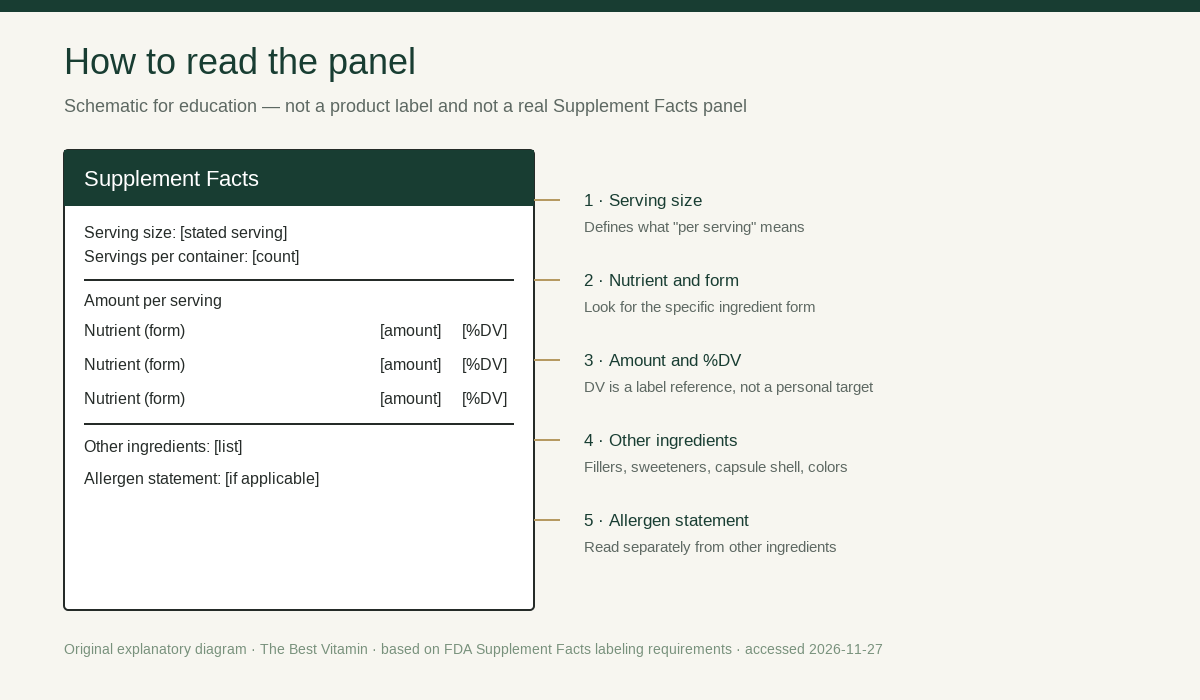
Vitamin D, calcium, iron, and potassium must appear on Nutrition and Supplement Facts labels. Other vitamins may appear voluntarily or when a nutrient content claim is made. If a vitamin is absent from the panel, that does not necessarily mean the product contains none — it may mean declaration was not required.