Vitamin D is fat-soluble and appears in supplements as either D2 (ergocalciferol) or D3 (cholecalciferol). Both can raise serum 25-hydroxyvitamin D, but they are not identical.
Sources and production

D2 is produced by ultraviolet irradiation of ergosterol in yeast and fungi; UV-treated mushrooms are a dietary source. D3 is typically produced from lanolin-derived 7-dehydrocholesterol; an animal-free lichen-derived version also exists. The body obtains D3 through sunlight-driven skin synthesis, which is highly variable and declines with age and darker skin pigmentation.
How the forms compare
NIH ODS reports that both forms are well absorbed and can raise 25(OH)D, but evidence indicates that D3 raises 25(OH)D more and maintains it longer than D2. This is a comparison of their effect on a status biomarker, not a claim about clinical outcomes.
Reading labels
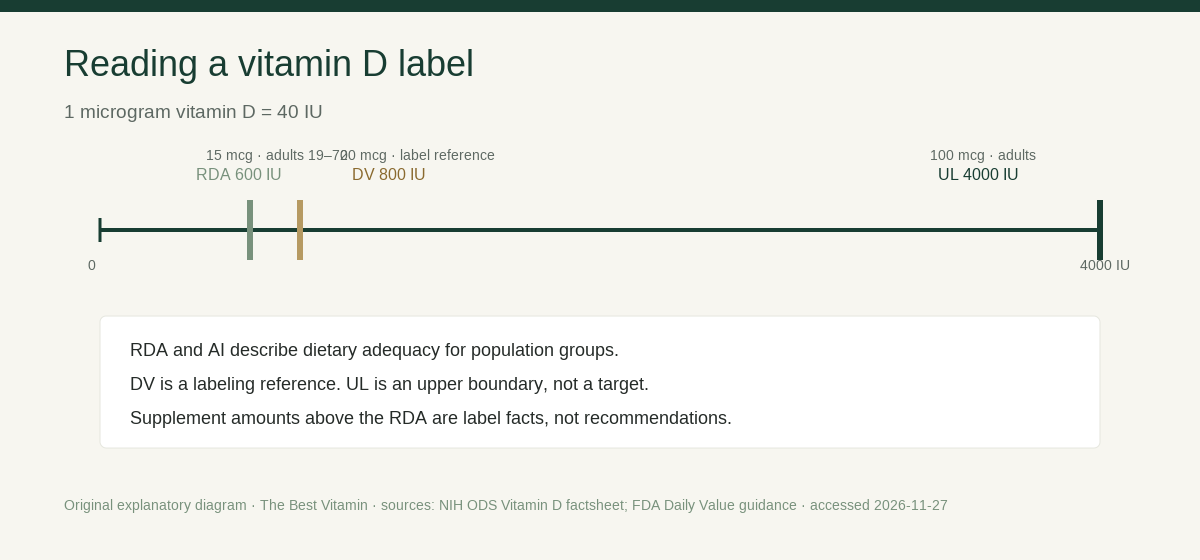
Vitamin D labels show micrograms, with IU optional in parentheses. One microgram equals 40 IU. FDA’s Daily Value is 20 mcg (800 IU). The adult RDA is 15 mcg (600 IU) through age 70 and 20 mcg (800 IU) over 70.
D + K combinations
Combination products pair vitamin D with vitamin K1 or K2. These should be compared as separate ingredients with separate amounts and forms; the presence of K does not change the D comparison. See our D3 + K2 buying guide.
Safety
Vitamin D toxicity is almost always associated with supplements rather than sunlight. The adult UL is 100 mcg (4,000 IU)/day. High calcium intake plus vitamin D increased kidney-stone risk in one large trial analysis.
Reference summary
- Common forms
- D2 (ergocalciferol) and D3 (cholecalciferol). Labels use mcg with IU in parentheses.
- Food sources
- Fatty fish, fish liver oils, egg yolks, cheese, UV-treated mushrooms (D2), fortified milk, plant milks, cereals and juices.
- Dietary reference values
- RDA adults 19–70: 15 mcg (600 IU); over 70: 20 mcg (800 IU). Pregnancy and lactation 14–50: 15 mcg. Infants: AI 10 mcg (400 IU). RDAs assume minimal sun exposure.
- Upper intake level
- Adults including pregnancy and lactation: 100 mcg (4,000 IU)/day.
- Safety notes
- Toxicity is almost always from supplements and causes hypercalcemia. Non-bone outcomes remain under study with mixed or insufficient evidence.