Vitamin B12 is a water-soluble nutrient required for red blood cell formation, DNA synthesis, and nervous system function. Products use several cobalamin forms, and marketing claims about them vary widely.
Common forms
Cyanocobalamin is the most widely used form in supplements. Methylcobalamin and adenosylcobalamin are coenzyme forms. Hydroxycobalamin is used in some supplements and injections. The metabolically active forms are methylcobalamin and 5-deoxyadenosylcobalamin; other forms are converted in the body.
Absorption claims
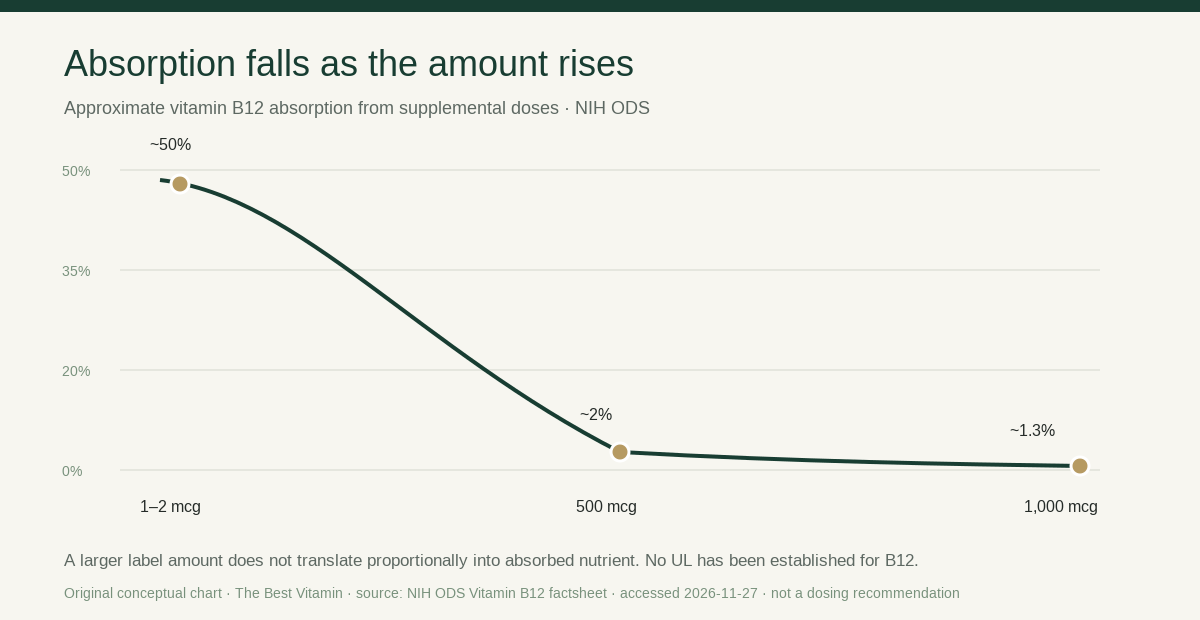
NIH ODS reports that absorption is roughly 50% at small doses (1–2 mcg), about 2% at 500 mcg, and about 1.3% at 1,000 mcg. It states that there is no evidence that absorption differs by supplement form, and that sublingual and oral forms appear equally effective. These points are important when evaluating marketing around “active” or “sublingual” B12.
Food sources and risk groups
B12 is found naturally in foods of animal origin. No plant food naturally contains it, though fortified cereals and nutritional yeasts can be good sources. Deficiency can also arise from pernicious anemia, atrophic gastritis, gastrointestinal surgery, malabsorption, and long-term use of certain medications.
Reference values and safety
The adult RDA is 2.4 mcg and no UL has been established. Body stores may be 1–5 mg, so deficiency signs can take years to develop. Neurologic symptoms can occur without anemia, which is why medical evaluation matters.
Evidence boundaries
Trials do not show cognitive improvement from B12 supplementation in people without deficiency, and B-vitamin supplementation has not shown cancer or cardiovascular mortality benefit in randomized trials.
Reference summary
- Common forms
- Cyanocobalamin, methylcobalamin, adenosylcobalamin, hydroxycobalamin. Prescription forms include injectable cyanocobalamin and hydroxycobalamin.
- Food sources
- Fish, meat, poultry, eggs, dairy, liver and clams; fortified cereals and fortified nutritional yeast. No plant food naturally contains B12.
- Dietary reference values
- RDA adults 19+: 2.4 mcg for men and women. Pregnancy 2.6 mcg; lactation 2.8 mcg. Infants: AI 0.4–0.5 mcg.
- Upper intake level
- No UL established because of low potential for toxicity.
- Safety notes
- Deficiency can occur despite adequate intake (pernicious anemia, atrophic gastritis, GI surgery, malabsorption, vegan diets, some medications). Neurologic symptoms can occur without anemia.